EXPERIENCE
END-TO-END UX RESEARCH
TIMELINE
12 MONTHS
TOOLS USED
FIGMA, MIRO, PLAYTESTCLOUD, DPPS
UX research for the LEGO Play App
Overview & challenges:
As part of the product team working on the LEGO Play app, I led continuous UX research to understand how children engage with digital play experiences and what drives meaningful, creative interaction.
The team was exploring how to expand play within the app, including features like stop motion creation. While early concepts showed promise, key questions remained around engagement, usability, and how to support more playful behavior, especially when children were playing alone.
To address this, I conducted iterative research combining in-person playtests and remote studies, observing both collaborative and solo play to uncover behavioral patterns, usability issues, and opportunities to improve engagement.
Role & approach
I led this research initiative end-to-end as the primary researcher embedded in the product team.
My responsibilities included:
Defining research objectives in collaboration with product and design stakeholders
Designing and facilitating playtests, both in-person and remote
Recruiting and moderating sessions with international participants
Conducting qualitative analysis using observation, interviews, and behavioral mapping
Synthesizing findings into actionable insights for the product team
Presenting research outcomes to designers and product managers to inform decisions
The research combined open-ended observation with structured analysis. Sessions were designed to let children interact naturally, prioritizing authentic behavior over task completion.
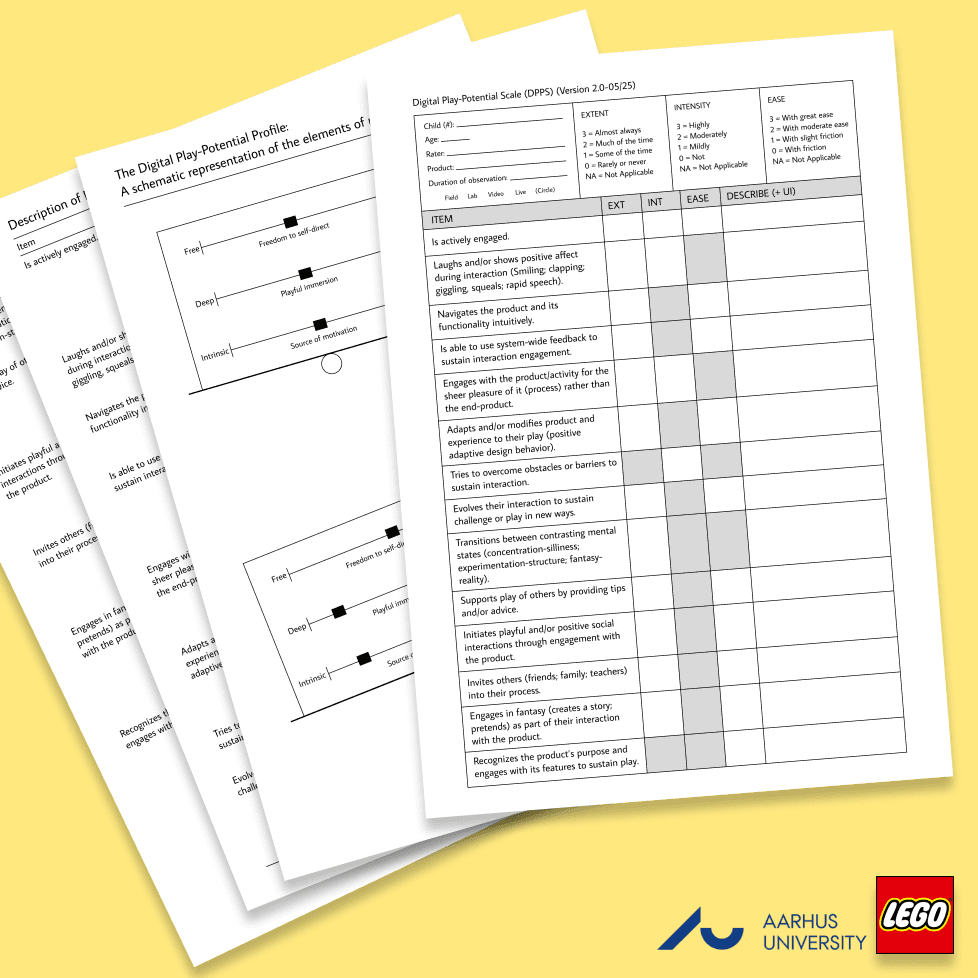
To support consistency and deeper analysis, I developed a structured evaluation framework, the Digital Play-Potential Scale (DPPS), used to assess engagement, motivation, and level of play across sessions. The framework enabled more systematic observation and reached an interrater reliability of 88%.
Impact & key insight
The research uncovered several important behavioral insights that directly informed product direction.
Play behavior & engagement:
Playing together significantly increased engagement, creativity, and laughter
When collaborating, children moved fluidly between structured creation and playful exploration
When playing alone, children were more likely to stay in “tool-focused” behavior and showed less expressive or playful interaction
This revealed a key tension:
The experience was intuitive and easy to use, but sometimes too structured to encourage playful exploration.
Play behavior emerged at the intersection of the expected and the unexpected. Interestingly, this balance between expected and unexpected appeared in how children interacted with each other during interaction with the product. They introduced spontaneity, humor, and unpredictability through social play. However, this meant that much of the “playfulness” existed outside the product itself, and was therefore less likely to occur when children engaged with the app alone.
Usability & mental models:
The interface aligned well with existing mental models, requiring little to no onboarding
However, specific UI elements created confusion:
The “+” button was sometimes interpreted as “save” instead of “add”
The “clear all” action was mistaken for “rotate”
Some users misunderstood system constraints such as frame limits
These issues highlighted gaps between system feedback and user expectations.
Product Impact:
The research directly informed how the team approached designing for engagement and play within the app.
Highlighted the importance of social and collaborative play as a key driver of creativity, enjoyment, and sustained engagement
Revealed that while the tool was easy to use, it often led to functional, tool-focused interaction rather than playful exploration
Shifted focus toward designing for more unpredictable and exploratory interactions, especially in solo contexts where playfulness was otherwise limited
These insights helped guide exploration of features and interaction patterns that support more expressive, intrinsically motivated play, rather than purely task-oriented use.
Testimonial:
Marie Louise’s work has played a crucial role in shaping the play experience for millions of children worldwide. She approaches her work with deep methodological insight, great attention to detail, and a strong sense of responsibility.

Joachim Blicher
Sr. Product Designer at the LEGO Group